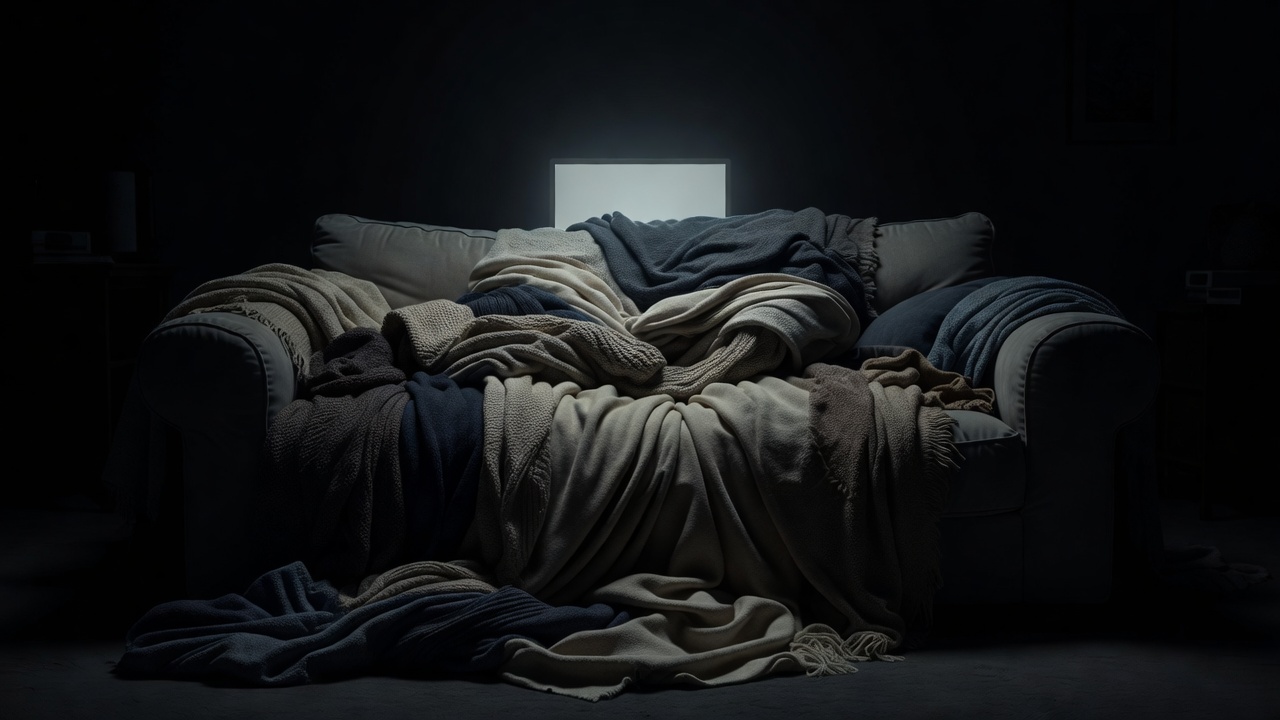
A cinema is a room designed to make you forget the room. At home, the task is gentler: to make the room remember what it is for, just for one evening.
By the Scoopwatflicknestl desk · Approx. 9 minutes
Picture houses were built around a few simple truths: the audience should be comfortable, the screen should fill the eye without straining it, the sound should arrive from where the picture is, and the outside world should disappear. None of these truths requires a dedicated home cinema or a large budget. They require attention. The nest, as we have come to call it at this desk, is the domestic version of that attention: a room temporarily rearranged so that a film can do its work.
First, the dark
Darkness is the most underrated element of the home movie night. Even modest screens look richer when the room around them is dim, because the eye stops adjusting to competing light. Heavy curtains, a lamp switched off rather than merely dimmed, a laptop closed in the next room: these small acts do more for the picture than most purchases.
Total darkness, however, is not always kind. Display calibration professionals often recommend a soft "bias light" behind the screen, ideally close to the D65 white point of roughly 6500 kelvin that television and film are mastered to.1 A faint, neutral glow behind the set eases eye strain and makes blacks appear deeper by contrast. It is a technical idea with an almost poetic result: the screen seems to float.
Then, the distance
How far should you sit? The film industry has offered guidance for decades. The Society of Motion Picture and Television Engineers has long suggested that a screen should fill about 30 degrees of the viewer's horizontal field of vision, while THX, the certification company founded by Lucasfilm in 1983, recommends a more immersive figure of around 36 to 40 degrees.23 In practical terms, many people sit too far from their screens. Drawing the sofa forward, or simply sitting on cushions on the floor, can transform an ordinary set into something closer to a cinema.
Drawing the sofa a metre forward does more for a film than any upgrade you might buy.
Height matters too. The centre of the screen should sit roughly at seated eye level, so that nobody spends two hours tipping their head back as though in the front row of an old picture palace.
Sound arrives before we notice it: a pair of decent speakers placed with care often matters more than their number.
The sound of the room
Film sound has grown elaborate, from stereo to 5.1 surround to object-based systems such as Dolby Atmos, which reached home equipment in 2014.4 Yet the principles remain modest. Dialogue should come from the screen. Speakers should be at roughly ear height and arranged so that the listener sits at the point of an equilateral triangle. Soft furnishings, which every nest has in abundance, quietly absorb harsh reflections. A rug and a bookcase are acoustic treatments by accident.
It is also worth defending restraint. A film played at a volume that rattles the windows does not feel larger, only louder. The aim is clarity: to hear a whisper without reaching for the remote, and to feel an explosion without waking the street.
Softness and the art of staying put
The word "nest" is chosen deliberately. Comfort is not an indulgence here; it is how the body agrees to sit still for two hours. Blankets within reach, a cushion for each back, a small table for the bowl and the glass, a dimmer for whoever must rise at the interval. The Danish idea of hygge, popularised abroad by Meik Wiking's The Little Book of Hygge in 2016, captured something many households already knew: that warmth, low light and company are their own kind of luxury.5
There is one more element, and it is not furniture. A nest is a shared space, so the rules should be shared too. Phones away, or at least face-down. No talking through the first scene. A pause allowed for the kettle, agreed in advance. Such rules sound fussy written down, but they are what turn a room full of people looking at a screen into an audience.
With the room arranged, there remains the question that every child asks within the first five minutes: what is there to eat? That is the subject of our next chapter.
Sources and Notes
ITU-R Recommendation BT.709 and the CIE Standard Illuminant D65, the reference white used in television and film mastering.
Society of Motion Picture and Television Engineers (SMPTE), viewing-angle guidance for screening rooms.
THX Ltd., founded 1983 by Lucasfilm; published home theatre viewing-angle recommendations.
Dolby Laboratories, Dolby Atmos for the home, introduced 2014.
Meik Wiking, The Little Book of Hygge: The Danish Way to Live Well, Penguin, 2016.
We use cookies We use necessary cookies to run the site and, with your consent, optional ones to measure visits. You can change this at any time. Read more