Chapter One of Four
Chapter One: On the Projector and the Stream
Every way we have ever watched films at home was once a novelty. To understand the evening we keep now, it helps to remember the machines that made it.
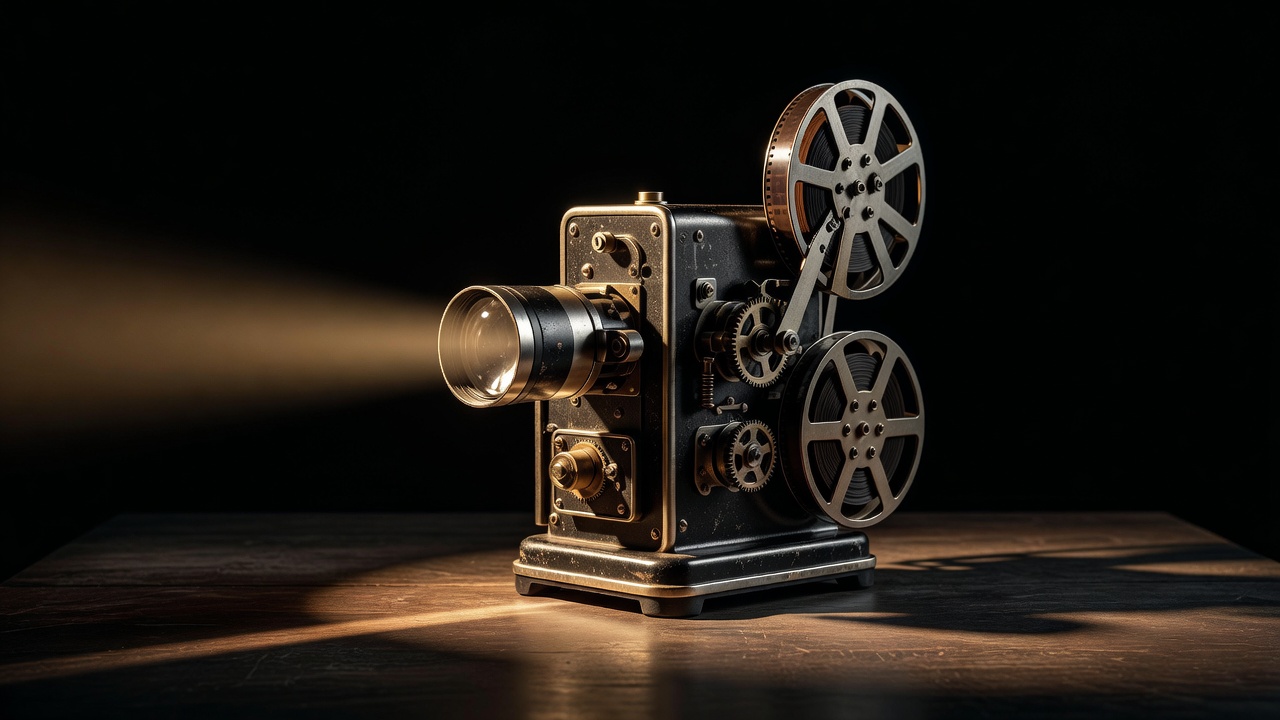
The first home cinemas were noisy things. In 1922 the French company Pathé introduced the Pathé Baby, a small hand-cranked projector using 9.5mm film, and sold it alongside short reels of comedies and newsreels that families could buy and play again and again.1 A year later Eastman Kodak launched 16mm film and the Cine-Kodak camera, aimed at amateurs who wanted to make their own pictures as well as watch other people's.2 The machines were expensive, the reels were short, and the experience involved hanging a sheet, threading film with careful fingers and listening to the clatter of the shutter. Yet something essential was already present: the household, gathered in the dark, facing one wall.
The reel in the parlour
Kodak's 8mm format, introduced in 1932, made the hobby cheaper still, and for several decades "home movies" mostly meant footage of birthdays and seaside holidays rather than feature films.2 Super 8, launched in 1965 with its easy-loading cartridges, extended that era into the colour-saturated memories many families still keep in shoeboxes. The rhythm of these evenings was set by the medium. A reel lasted minutes, not hours. Someone had to stand by the projector. The show was an event, announced in advance and attended almost formally.
It is worth pausing on that formality, because it never quite left us. The habit of dimming the lights, of asking for quiet, of treating the screening as a shared occasion, was learned in those parlours long before the television set took up its place in the corner.
The machines changed every decade. The gathering in the dark, facing one wall, did not.
The tape that changed the evening
Television brought films into the home by broadcast, but on the broadcaster's schedule. The real revolution was the videocassette. Sony's Betamax went on sale in 1975 and JVC's VHS followed in Japan in 1976; after a celebrated format war, VHS became the household standard across much of the world.3 For the first time a family could choose a feature film, bring it home, and watch it when it suited them.
The rental shop became a weekend institution. Blockbuster opened its first store in Dallas in 1985, but long before and alongside it thousands of independent shops, corner stores and even petrol stations kept shelves of boxes with faded covers. The walk down those aisles became a ritual of its own, often longer and more argumentative than the film that followed. Choosing, as we shall see in Chapter Four, has always been half the evening.
The tape also changed the texture of watching. You could pause for the kettle. You could rewind a scene. Films became objects to be owned, lent and worn out, and children of the period remember particular tapes the way earlier generations remembered favourite books.